Polymerization Catalyst Ferric Sulphate About
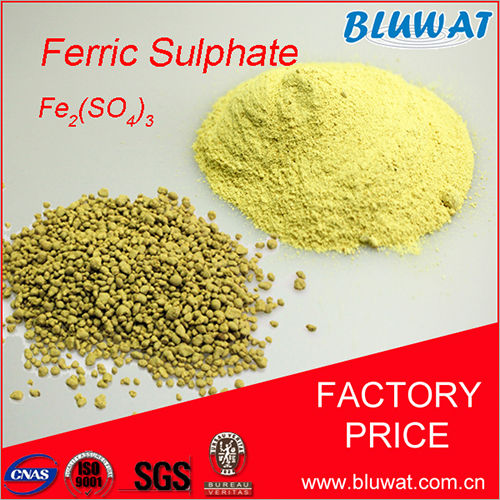
Our firm has become instrumental in offering Polymerization Catalyst Ferric Sulphate that is made available for clients in various packaging options. The provided chemical is widely demanded in printing and pharmaceutical industries. This chemical can be purchased from us in different packaging options at economical rates. By a team of deft professionals, the offered Polymerization Catalyst Ferric Sulphate is processed at modern processing unit.
Key points:
-
Longer shelf life
-
Non toxic
-
Accurate pH value
-
Effectiveness
Polymerization Catalyst Ferric Sulphate
Ferric Sulphate Features:
- High quality and efficient inorganic polymer coagulant.
- Good coagulation function with thick flocs and fast sedimentation.
- Excellent purifying effect.
- Safe, reliable, nonpoisonous and harmless: doesn't contain any harmful substances such as aluminum, chlorine, heavy metal ions, pesticide, and water phase transference of iron ions.
- Can be used in discolouring, dehydrating, deodorizing, degreasing, sterilizing as well as discarding heavy metal iron, radioactive substance and carcinogens in the water, and eliminate COD, BOD, and color.
- Can treat water with PH from 4 to 11, (the optimum pH is 6-9), PH barely changes after treatment, and has little corrosiveness effect to the equipment
- Has very good effect in purifying the river water with algae, low temperature and low urbidity, and slightly contaminated.
Has a better effect in purifying the high turbidity river water
Ferric Sulphate Specifications:
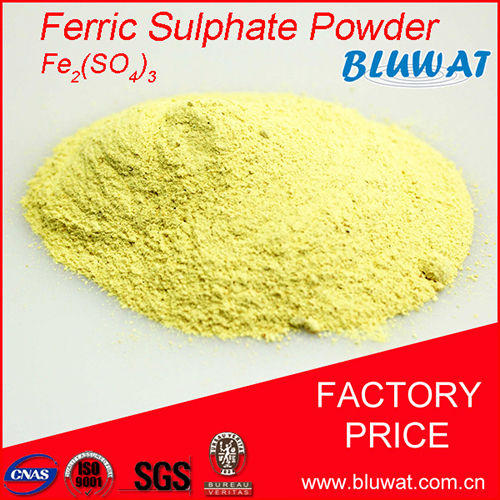
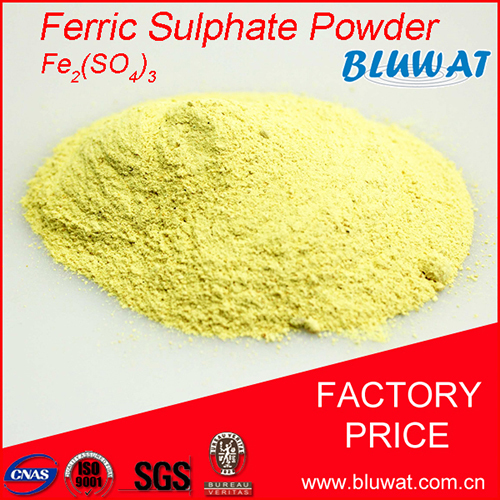
- Fe content: 19% (min.)
- Fe2+ content: 0.15% (max.)
- PH (1% water solution): 2.0 - 3.0
- Insolubles: 1.0% (max.)
Ferric Sulphate Application:
- Before using, dissolve the product in running water in the proportion of 10-30% to have red brown solution, then dilute it to dosing solution required for coagulation, the concentration of dosing solution is 2 - 5% for drinking water treatment, and 5-10% for waste water treatment
- Optimum dosage: viewing the different property of raw water, it can be determined by the experiment. For the waterworks, you may refer the dosage of other flocculant operated before. Under the same conditions, its dosage is almost equal to the poly aluminum chloride, 1/3 - 1/4 of the solid alum .
Packaging & Shipping
Package and Storage:
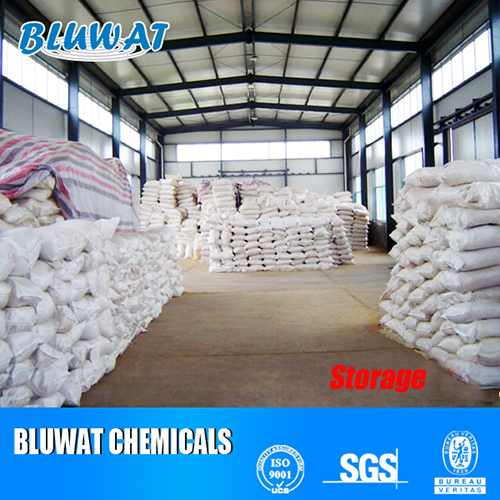
- It is harmless, no-flammable and non-explosive, it can be stored at room temperature, it can not be placed in the sun.
- 25kg/polypropylene woven bags with inner plastics bag
- Storage temperature: 5-30C.
- The product would show slightly stratification or appear white at low temperature. There is no negative impact on the performance after mixing up.
Our Services:
We have more than 15 year experience and more than 20 engineers for production research and after-sales service, advanced lab equipments can satisfy your testing requirements.
VIP Service
Dedicated Customer Service Specialist to help guiding clients to use the products.
Customer Care
Regular detailed tracking reports keep customers updated on their application performance, to provide professional suggestions and solutions to help you get more benifits and cut down the cots.
Versatile Applications for IndustryFerric Sulphate is a key catalyst in polymerization processes for the plastics and chemical sectors. Its coagulation properties extend its utility to water and wastewater treatment, ensuring effective removal of impurities. This multi-functional compound finds favor with manufacturers, suppliers, and distributors worldwide due to its efficacy and adaptability across industries.
Efficient Solubility and StabilityDesigned for instant solubility, Ferric Sulphate quickly disperses in water, making it easy to handle during industrial processing. It remains stable under regular storage and operation temperatures, ensuring consistent catalyst performance and reliability over its 24-month shelf life when stored as directed.
Safe Handling and Long Shelf LifeNon-toxic under correct usage and odorless, Ferric Sulphate poses minimal risk during handling. Store this product in its original packaging in a cool, dry, and well-ventilated location to maintain its effectiveness and extend its shelf life for up to two years.
FAQs of Polymerization Catalyst Ferric Sulphate:
Q: How should Ferric Sulphate be stored to maintain its quality?
A: Ferric Sulphate should be stored in a cool, dry, and ventilated area, away from moisture. Keeping it in its original tightly sealed 25/50 kg bags helps preserve its quality throughout its 24-month shelf life.
Q: What are the main industrial uses of Ferric Sulphate polymerization catalyst?
A: This product is primarily used as a catalyst in polymerization processes, especially in the plastics and chemical industries, as well as a coagulant in water and wastewater treatment plants due to its strong performance and effectiveness in removing impurities.
Q: When is Ferric Sulphate most effective in polymerization reactions?
A: Ferric Sulphate exhibits optimal catalytic activity when used under ambient temperatures and in aqueous environments, thanks to its complete solubility and high purity. It should be applied as recommended for best results in polymerization reactions.
Q: Where can Ferric Sulphate be used apart from polymerization?
A: Beyond polymerization, Ferric Sulphate is widely employed in water treatment facilities to clarify and purify water and as a coagulant in various chemical processes within manufacturing operations.
Q: What is the process for dissolving Ferric Sulphate for industrial use?
A: Ferric Sulphate dissolves rapidly in water, forming a clear solution with negligible residue (insoluble content 0.5%). Use clean equipment and water at ambient temperature for best results.
Q: How does Ferric Sulphate benefit water treatment applications?
A: Due to its strong cationic properties and high acid resistance, Ferric Sulphate efficiently aggregates colloidal particles in water, making it easier to remove contaminants and improving overall water clarity and quality.
Q: Is Ferric Sulphate safe to use, and what precautions should be taken?
A: Ferric Sulphate is non-toxic and odorless when handled and used as directed. However, standard industrial safety practices should be followed, including wearing gloves and protective eyewear to avoid direct contact with the product.








 Send Inquiry

 Send Inquiry


